
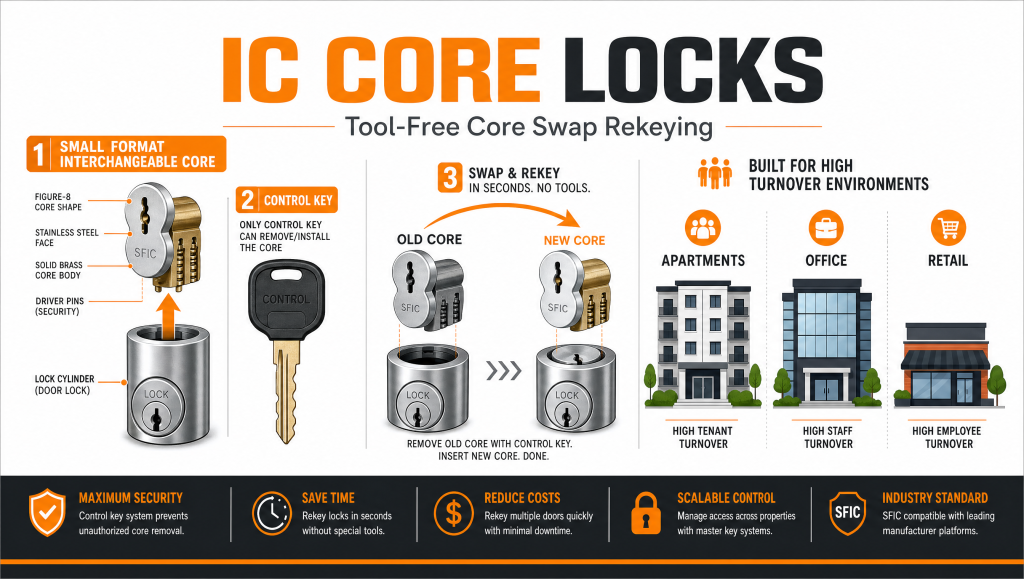
Managing a property where staff or tenants change often means one chore keeps coming back: every departure leaves a working key in someone else’s pocket, and the traditional answer is to pull a locksmith out to dismantle each cylinder one opening at a time. IC core locks (interchangeable core) solve this by letting an authorized control key lift the entire core out of a lock and drop a freshly keyed one in its place — no teardown, no door out of service. Below, our Tucson team explains how interchangeable core hardware works, where it earns its keep, and how it compares to standard cylinders so you can plan smarter access for your building.
What Are IC Core Locks? (Interchangeable Core Explained)
An IC core lock keeps its pin chambers inside a removable cylinder called a core. Instead of one key that does everything, the system uses two: an operating key for daily access, and a control key that releases the core from the housing. Turn the control key, the core slides out, a new core slides in, and the opening is rekeyed in a single step.
These cores come in two main families. Small Format Interchangeable Core (SFIC) uses the recognizable figure-eight shape and follows an open industry standard, so it fits hardware from many manufacturers. Large Format Interchangeable Core (LFIC) is brand-specific and built into proprietary lines. The SFIC concept was pioneered by Best Lock and is now a fixture in schools, hospitals, and offices nationwide. Quality cores are graded against ANSI/BHMA standards for durability and security, the same benchmarks our technicians reference when specifying commercial hardware.
If you want a broader look at how rekeying differs from full replacement, our guide on rekeying versus replacing a lock covers the fundamentals that interchangeable cores build on.
The difference between an interchangeable core and a conventional cylinder shows up the moment a key needs to change. Here is how the two stack up across the features that matter to a busy property.
| Feature | IC Core (Interchangeable) | Standard Cylinder |
|---|---|---|
| Rekeying method | Swap the core with a control key | Disassemble the lock and re-pin |
| Operational disruption | Minimal — the door stays in service | The opening is taken apart in place |
| Who can rekey | A trained manager or a locksmith | A locksmith at each lock |
| Master key integration | Designed for large keying systems | Limited and harder to expand |
| Scalability across many doors | Excellent | Cumbersome |
| Spare cores kept on hand | Yes — pre-pinned and ready | Not applicable |
| Security grade options | SFIC and LFIC up to high-security | Standard grades |
| Best fit | High-turnover properties | Single-family, low-change doors |
For a deeper comparison of hardware strength, our overview of high-security deadbolt benefits pairs well with the table above.
How IC Core Rekeying Works for High-Turnover Businesses
The workflow is what makes interchangeable core locks so practical. A property keeps a small inventory of pre-pinned spare cores. When an employee resigns or a tenant moves out, an authorized person uses the control key to remove the active core and install a fresh one. The departing key no longer opens anything, and the building never has an opening sitting exposed while a technician re-pins it in place.
This is the same logic behind professional business lockout and rekeying work, scaled so a manager can handle routine changes between visits from a professional locksmith.
SFIC vs. LFIC: Which Belongs in Your Building
Small format cores give you the widest hardware compatibility and the easiest path into an open keying system, which is why we recommend SFIC for most multi-door properties. Large format cores make sense when a facility is already standardized on a specific manufacturer’s line. Our technicians evaluate existing commercial lock hardware before recommending a format, because mixing systems creates more keys to track, not fewer.
The Control Key Advantage
The control key is the heart of the system. It centralizes who can change cores, and it slots neatly into a structured master key system so a single management key can open grouped doors while individual cores stay unique. Used well, interchangeable cores also complement access control and electronic locks and keyless entry systems on your most sensitive entries.
Where Interchangeable Core Locks Make the Biggest Difference
IC cores shine anywhere keys change hands often. Apartment complexes and vacation rentals reset units between residents. Multi-tenant offices and co-working suites adjust access as companies grow or leave. Retail stores, medical practices, and schools rotate staff and contractors. Across our commercial locksmith work in Tucson, the properties that benefit most are the ones where a misplaced key used to mean a round of re-pinning every affected door.
These cores aren’t only for businesses. Homeowners managing rooms, casitas, or shared entries can use interchangeable hardware too — our residential locksmith team and our lock upgrade and maintenance service handle both worlds.
IC Cores, Deadbolt Security, and Thumbturn Locks
A common question is how interchangeable cores fit with the rest of a door’s hardware. The answer: cleanly. IC cores drop into deadbolts, lever sets, padlocks, and cabinet locks, so you can layer convenience over real deadbolt security rather than trade one for the other. On a typical exterior commercial door, the keyed IC core faces the street while an interior thumbturn lock lets people exit without a key — a setup that supports both code-compliant egress and everyday home safety.
When a building’s exterior openings need hardening alongside an IC retrofit, we often pair cores with security door locks, high-security and smart locks, and proper deadbolt and knob installation. For protected file rooms and storage, cabinet, desk, and file locks accept compatible cores as well.
Pro Tip From the Field
After years of building keying systems for Tucson properties, the single best habit we share with managers is this: stage your spare cores before you need them. Keep two or three pre-pinned cores labeled and stored in a secured cabinet, log every core and key by opening, and store the control key separately from the operating keys — never on the same ring. We also design the master schematic on day one, even if a property starts small, because retrofitting a keying hierarchy later is far harder than planning it from the start. A short walk-through with our team during a routine commercial lock maintenance and upgrade visit catches most issues before they ever reach a door.
Frequently Asked Questions — IC Core Locks
Can I rekey an IC core lock myself?
Are interchangeable cores secure?
Will IC cores work with my existing doors?
What is the difference between the operating key and the control key?
Do IC cores fit into a master key system?
Are IC core locks only for businesses?
Build a Smarter Access Plan for Your Tucson Property
Interchangeable core locks turn key control from a recurring scramble into a routine your team manages on its own terms. If your building sees regular turnover, the next step is a walk-through to map your openings, choose between SFIC and LFIC, and set up a control key and master schematic that grow with you. Our certified technicians have built these systems across Tucson and the surrounding service areas, and we are glad to design one around your doors.
Reach out for a hardware consultation or a full security audit through our contact page, explore everything our Tucson locksmith team offers, or find us on our Google Maps listing. Call Discount Locksmith of Tucson at (520) 994-8773 and let’s put a smarter keying system to work for your business.