How to rekey a lock is one of the most common questions we hear from Tucson homeowners who want to control exactly who can open their doors without paying for brand-new hardware. Rekeying changes the internal pins inside your existing lock so every old key stops working and a single new key takes over. In the guide below, our certified Discount Locksmith of Tucson team walks you through the tools, the steps, the mistakes to avoid, and the moments when it’s smarter to call a pro. Whether you just moved in, lost a key, or parted ways with a roommate, you’ll finish knowing precisely what to do.
What Does It Mean to Rekey a Lock?
Rekeying is the process of resetting the pins inside a lock cylinder so the lock accepts a different key while the rest of the hardware stays exactly where it is. The lock body, the bolt, the strike plate, and the finish on your door all remain untouched — only the tiny pin stack inside the cylinder changes. After more than a decade of residential locksmith work across Pima County, we can tell you this is the fastest, most affordable way to invalidate keys you no longer trust.
People often confuse rekeying with replacing a lock, but they solve different problems. Replacing swaps out the entire mechanism and is the right move when hardware is damaged, corroded, or outdated. Rekeying keeps your trusted lock installation intact and simply changes the key that works it. We rekey deadbolts, knobs, and levers every week, and the same principle applies whether you own a single-cylinder deadbolt or a full master key system for a small business.
Another point worth clearing up: rekeying is not the same as key duplication. Duplicating copies an existing key so more people can use it, while rekeying does the opposite — it shrinks access down to one fresh key you control. If your goal is security after a move or a lost key, rekeying is almost always the answer. To help you weigh your options, here’s how rekeying stacks up against full replacement.
| Factor | Rekeying a Lock | Replacing a Lock |
|---|---|---|
| Best for | New move-ins, lost keys, ex-roommates, matching several locks to one key | Damaged, worn, or outdated hardware and security upgrades |
| Existing hardware | ✔ Kept in place | ✘ Removed entirely |
| Old keys still work? | ✔ No — instantly invalidated | ✔ No — new keys only |
| Match many locks to one key | ✔ Easy | ✘ Requires matched hardware |
| Upgrades security grade | ✘ Keeps current grade | ✔ Yes, with high-security locks |
As the table shows, rekeying wins on speed and convenience, while replacement wins when you want stronger hardware. If your locks are in good shape and you simply want new keys, keep reading — the process is very doable. If you’d rather skip the bench work entirely, our lock rekey service handles it at your door.
Tools You’ll Need
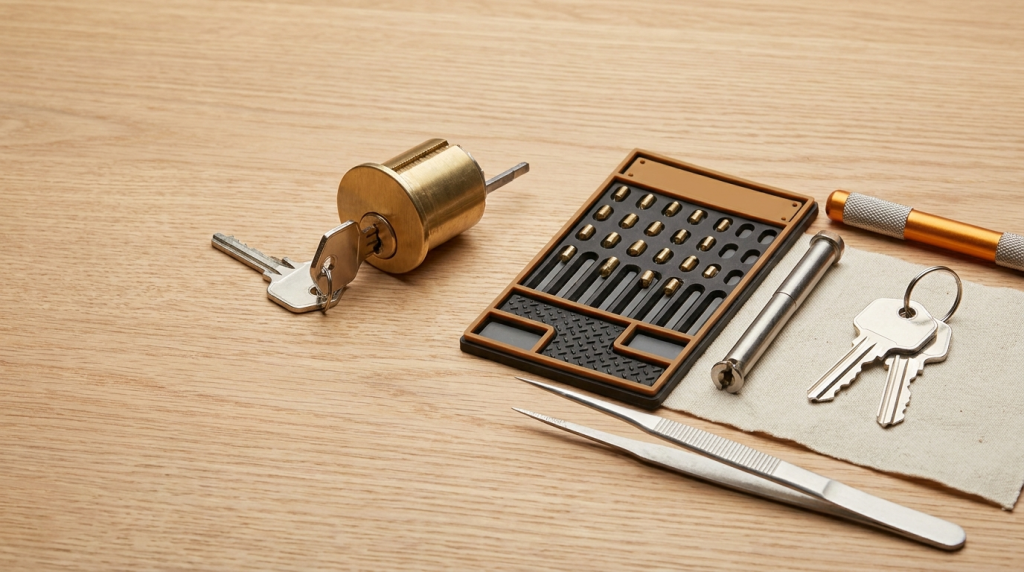
Before you begin, gather everything in one place so you’re not hunting for a spring halfway through. The single most important item is a rekey kit that matches your lock brand — Kwikset and Schlage kits are not interchangeable, and using the wrong one is the number-one reason DIY rekeys fail. Our technicians keep brand-specific kits on every truck for exactly this reason, and we recommend the same discipline at home.
Here’s the short list we’d hand a first-timer:
- Brand-matched rekey kit — includes a key gauge, plug follower, and an assortment of bottom pins.
- The current working key — you need a key that already opens the lock to remove the cylinder cleanly.
- Two new blank keys — cut to the same keyway; a quick key cutting stop covers this.
- Small flat-head and Phillips screwdrivers — for the cylinder retainer and door hardware.
- Tweezers or a pinning tray — those pins are tiny, and Tucson floors love to hide them.
- A clean, well-lit work surface — a towel on a table keeps springs from rolling away.
If any of this feels like a lot to source for a single door, that’s a fair signal to consider professional help. The same kit and steps apply whether you’re securing a home after a move or coordinating a property with our commercial locksmith team — only the volume changes. You can always reach our Tucson shop on the map if you’d rather have us cut the blanks for you first.
Step-by-Step Rekeying Process
With your kit ready, you’re set to rekey a lock from start to finish. We’ve broken the job into three clear stages. Work slowly the first time — once you’ve done it on one cylinder, every lock after it goes faster.
Remove the Lock Cylinder
Start by taking the lock off the door, or at least exposing the cylinder. For a typical deadbolt, remove the two screws on the interior thumbturn side and pull the lock apart so the cylinder slides free. On a knob or lever, you’ll usually depress a retainer clip with your flat-head to release the cylinder. Insert your current working key and turn it slightly — about a quarter turn — so the plug can rotate within the housing.
Next, use the plug follower from your kit to push the plug out the back of the cylinder. This is the most delicate moment: the follower must stay in constant contact with the plug so the top pins and springs don’t spill out into the housing. Keep gentle, steady pressure and the plug will slide out with the key still inserted. If a spring does escape, don’t panic — our lock repair crews recover dropped springs daily, and a magnetic tray makes it easy.
Replace the Pins
With the plug in hand, turn the key so the old bottom pins lift out, then remove that key. Now insert your new key into the plug. Using your kit’s key gauge, read which pin sizes the new key calls for — each cut depth corresponds to a numbered bottom pin. Drop the matching pins into each chamber so they sit flush with the top of the plug when the new key is fully seated. This is the heart of how rekeying works: the new pin stack now lines up perfectly with the new key’s cuts.
Double-check that every pin is level across the shear line before moving on. A single mismatched pin will keep the lock from turning, and chasing that error after reassembly is frustrating. Our team treats this verification step as non-negotiable, the same care we bring to fitting a smart lock or a precision high-security cylinder. When the pins look even, slide the plug back into the housing, pushing the plug follower out the opposite end so the top pins and springs reseat correctly.
Test the New Key
Before you put the lock back on the door, test it in your hand. Insert the new key, turn the plug both directions, and remove the key several times. It should turn smoothly with no grinding or sticking. Then confirm the security half of the job: try the old key. It should no longer turn the plug at all — that’s the whole point of learning how to rekey a lock.
Once the bench test passes, reinstall the hardware on the door and run the same checks in place. Lock and unlock from both sides, and test your second new key too. If everything operates cleanly, you’ve successfully rekeyed your lock. If it binds or the old key still works, head to the next section before you tear it apart again. A door that locks reliably is also your first defense against techniques like lock bumping, so it’s worth getting right.
Common Mistakes to Avoid
Most failed rekeys trace back to a handful of avoidable errors. We’ve rescued enough DIY attempts across Tucson, Oro Valley, and Marana to know exactly where things go sideways:
- Using the wrong brand kit. Schlage pins in a Kwikset plug will never seat correctly. Match the kit to the lock first.
- Losing the springs. Letting the plug follower lose contact sends top pins and springs flying. Keep them touching at all times.
- Mixing up pin sizes. Reading the key gauge in poor light leads to one wrong pin and a lock that won’t turn. Work where you can see clearly.
- Forcing the plug. If it won’t slide, a pin is misaligned. Stop and recheck rather than jamming it home.
- Skipping the old-key test. Always confirm the old key fails. If it still works, the rekey didn’t take.
- Rekeying a damaged cylinder. Worn or corroded hardware should be replaced, not rekeyed — that’s when our lock installation service makes more sense.
If you hit two or more of these snags on a single lock, that’s usually the moment our customers call. There’s no shame in it — even seasoned DIYers run into stubborn cylinders, and a quick visit from our emergency locksmith beats a door you can’t secure overnight.
When to Call a Professional Locksmith
Plenty of homeowners rekey a simple deadbolt without trouble, and we love seeing that confidence. Still, some situations genuinely call for a trained, certified locksmith — and knowing the difference is part of doing the job right. We’ve spent years training our technicians on factory hardware, modern keyways, and Arizona security standards, and that experience matters most in the cases below.
Reach out to a professional when you’re dealing with high-security or restricted-keyway locks, when you need several doors keyed alike across a home or office, when a lockout has left you without a working key to remove the cylinder, or when the hardware shows wear that points toward replacement instead. These are everyday calls for our team, whether it’s a residential rekey, a fleet of office doors, or an automotive locksmith job that DIY kits simply don’t cover.
Choosing a certified locksmith also protects you. Our technicians are background-checked, insured, and trained to factory specs, and we stand behind every rekey we perform. That accountability is hard to replicate with a hardware-store kit, and it’s why so many Tucson families keep our number saved. If you’d like to talk through your specific locks, you can contact our team or visit our about page to meet the people behind the work. For a deeper look at budgeting the job, our breakdown of what rekeying costs is a helpful next read.
Frequently Asked Questions — How to Rekey a Lock
Can I rekey a lock myself without any locksmith experience?
Does rekeying a lock make the old keys stop working?
Can all my locks be rekeyed to use the same key?
Is it better to rekey or replace a lock?
What if I lost the only key — can the lock still be rekeyed?
Rekey Your Locks in Tucson
Now that you know how to rekey a lock, the next move is deciding whether this is a satisfying Saturday project or a job worth handing to a pro. If you enjoy hands-on work and own a standard deadbolt, grab a brand-matched kit and put these steps to use — you’ll gain real control over who holds your keys. If the lock is high-security, the door won’t cooperate, or you simply want it done once and done right, that’s where our certified technicians shine. While you’re planning, our guide to choosing high-security deadbolts pairs perfectly with a fresh rekey for a stronger entry overall.
At Discount Locksmith of Tucson, we’ve built our reputation on honest work for homeowners and businesses across Tucson, Oro Valley, Marana, Sahuarita, and Green Valley. Every rekey is handled by a trained, background-checked technician who treats your security like our own. When you’re ready, book a rekey, explore our full range of residential locksmith services, and find us on Google to see why your neighbors trust us — visit our Tucson location on the map and reach out today. Your doors, your keys, your peace of mind — let’s get them back under your control.