
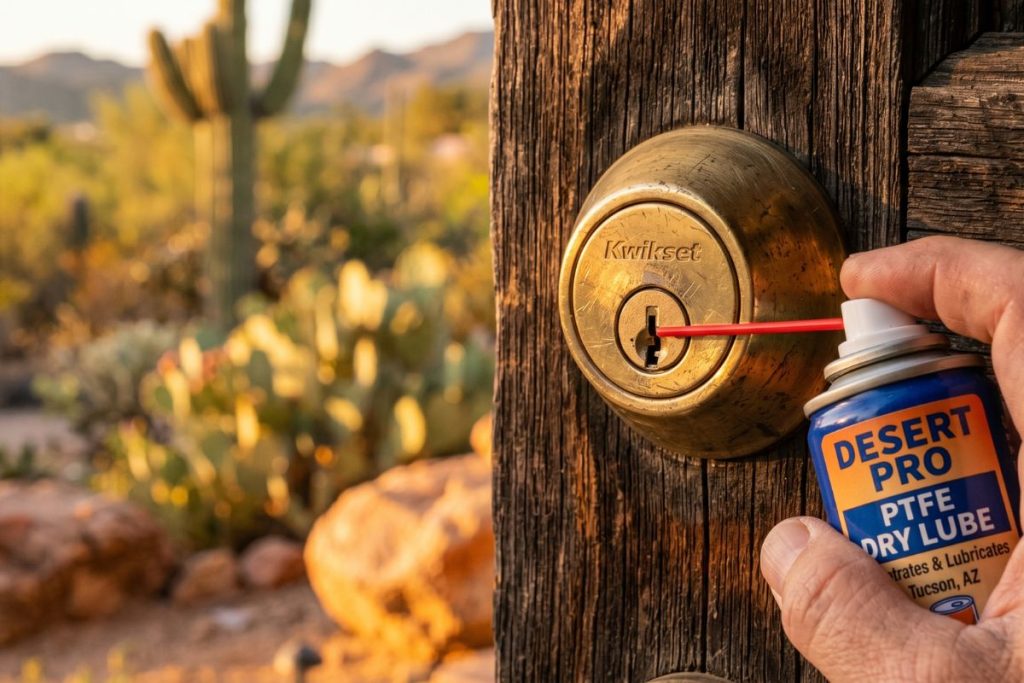
A sticky lock is one of those small annoyances that turns into a real problem the moment you’re standing outside your home in Tucson’s summer heat, key in hand, and the deadbolt simply won’t cooperate. The good news is that most sticky lock problems come down to one thing: improper or missing lubrication. Knowing how to lubricate a lock correctly — and which products to use — can extend the life of every lock in your home and prevent unnecessary lockouts. In this guide, we walk you through the right technique, the right products, and the warning signs that tell you it’s time to call a professional locksmith instead of reaching for the WD-40.
Why Locks Get Sticky — and Why Tucson Makes It Worse
Tucson’s climate is genuinely tough on lock hardware. With summer temperatures regularly exceeding 100°F, the metal components inside your deadbolts and thumbturn locks expand, contract, and collect fine desert dust year-round. Over time, that dust mixes with whatever lubricant was originally applied — or with nothing at all — and creates a gritty paste inside the lock cylinder that makes every turn of the key feel like you’re fighting the lock.
We’ve responded to residential locksmith calls across Tucson where the homeowner assumed the lock was broken, only to find that a proper cleaning and lubrication brought it back to full function in minutes. This is one of the most preventable service calls in the industry, and it starts with understanding what’s actually happening inside your lock.
A standard pin tumbler lock — the kind found in most residential deadbolts — contains a series of spring-loaded pins that align when the correct key is inserted. When those pins are coated in the wrong lubricant or are dry from years of neglect, the springs lose tension and the pins drag against the cylinder walls. The result: a key that turns with resistance, a thumbturn that requires two hands, or a bolt that refuses to extend fully.
If you’ve noticed your front door lock getting progressively harder to operate, that’s not the lock aging gracefully — that’s a maintenance gap that’s getting wider. Check our Google Maps listing to see how many Tucson homeowners have already trusted us with their lock maintenance and repair needs.
The Right Products for Lock Lubrication — Comparison at a Glance
Before we get into technique, product selection matters more than most people realize. Using the wrong lubricant is often worse than using nothing at all.
Lock Lubricant Comparison: Which Product Belongs in Your Lock?
Product Type Best For Dust Attraction Long-Lasting? Recommended PTFE / Teflon Dry Spray Dry lubricant Pin tumbler, deadbolts, thumbturn locks Very Low ✅ Yes (12+ months) ✔ Highly Recommended Graphite Powder Dry lubricant Older keyed locks, padlocks Low ✅ Yes (6–12 months) ✔ Recommended Silicone Spray Wet lubricant Bolt mechanism, hinges, exterior metal Moderate ⚠️ Moderate (3–6 months) ⚠ Use Externally Only WD-40 (Original) Solvent / water displacer Removing rust — NOT lock cylinders High ❌ No (weeks) ✘ Not Recommended WD-40 Specialist Dry Lube Dry lubricant Pin tumbler, keyed locks Low ✅ Yes (6–12 months) ✔ Acceptable 3-in-1 Oil Wet lubricant Hinges only — not lock cylinders High ⚠️ Short (1–3 months) ✘ Avoid for Locks Petroleum Jelly Grease Key shank — temporary fix only Very High ❌ No ✘ Avoid Manufacturer Lock Lube Varies by brand Brand-specific locks (Schlage, Kwikset) Low ✅ Yes ✔ Best for Smart Locks
The table above makes it clear: not all lubricants belong inside a lock. WD-40 is a solvent and water displacer — it was never designed as a long-term lock lubricant. It loosens grime temporarily but leaves behind a residue that attracts more dust over time, accelerating wear inside the cylinder. Our home security specialists have seen this pattern repeatedly in homes across Oro Valley, Marana, and Green Valley — a well-intentioned can of WD-40 applied once a year, slowly destroying the lock’s internal components.
What actually works:
- PTFE (Teflon-based) dry lubricants — the gold standard for pin tumbler and deadbolt locks. They go on wet, dry quickly, and leave a slick, dust-resistant coating that doesn’t attract grime.
- Graphite powder — a traditional option that works well for older keyed entry locks and padlocks, though it can migrate and stain light-colored door finishes.
- Silicone spray — acceptable for the external moving parts of a lock (like the bolt mechanism), but not ideal for the keyway cylinder itself.
- Manufacturer-specific lubricants — if your home is equipped with a Schlage, Kwikset, or smart lock system, the brand often recommends a specific product.
If you’re already using a smart lock or keypad entry system, lubrication requirements are different — most electronic locks have mechanical fallback cylinders that still need PTFE treatment, but the electronic components require their own care protocol.
How to Lubricate a Lock Step by Step
This process applies to standard deadbolts, keyed entry knobs, and thumbturn locks — the most common lock types we service across Tucson’s residential neighborhoods.
Step 1: Start With a Clean Keyway
Before applying any lubricant, use compressed air to blow out any loose dust or debris from the keyway. In Tucson, where fine caliche dust infiltrates everything, this step makes a visible difference. Hold the can upright and direct short bursts into the keyway — don’t shake the can first or you’ll introduce moisture.
If the lock has been neglected for years, consider inserting and removing the key several times after the compressed air treatment to help dislodge any debris that the airflow didn’t reach.
Step 2: Apply PTFE Lubricant Directly Into the Keyway
Insert the thin application nozzle of your PTFE spray into the keyway and apply a short, controlled burst — about one second. Less is more here. Overapplication creates a pool of lubricant that attracts the same dust you just removed.
If you’re using graphite powder, insert the tip of the graphite tube and give the tube a firm squeeze while slowly pulling it out of the keyway. This distributes the powder evenly across the pin stack.
Step 3: Work the Key Through the Lock
Insert your key and cycle it through the full rotation several times — locked, unlocked, locked again. This distributes the lubricant across all the internal components: the driver pins, key pins, and the cylinder walls themselves. You should feel the resistance decrease noticeably with each cycle.
Step 4: Lubricate the Bolt Mechanism
The bolt — the part that extends into your door frame — also needs attention. Apply a small amount of silicone spray or dry lubricant to the face of the bolt itself, then cycle the deadbolt in and out several times using the thumbturn or key. This prevents the bolt from dragging against the strike plate, which is a separate but related cause of sticky operation.
If your door lock is misaligned with the strike plate, lubrication alone won’t fix the problem — the strike plate may need adjustment, which is a job for a trained technician.
Step 5: Wipe the Exterior
Use a clean cloth to wipe any excess lubricant from the keyhole face, the thumbturn, and the door surface. PTFE sprays dry clean, but graphite and silicone can leave visible residue on painted surfaces.
Pro Tip: Lubrication Schedules by Lock Type
One of the most consistent things we hear from Tucson homeowners is that they only think about lock maintenance after something goes wrong. A proactive schedule prevents that.
Lock Lubrication Schedule by Lock Type
| Lock Type | Recommended Frequency | Notes |
|---|---|---|
| Standard Deadbolt (interior) | Every 12 months | Increase to every 6 months if key is used daily |
| Keyed Entry Knob | Every 12 months | Check bolt alignment annually |
| Exterior Deadbolt (exposed) | Every 6 months | Tucson dust accelerates internal degradation |
| Padlock | Every 6 months | Use graphite if exposed to occasional rain |
| Smart Lock (mechanical cylinder) | Every 12 months | Follow manufacturer guidelines for electronics |
| Commercial Lock (high-traffic) | Every 3–6 months | More frequent use requires more frequent maintenance |
Our commercial locksmith team handles lubrication and maintenance contracts for businesses throughout Tucson and the surrounding Pima County area. High-traffic doors — like those at retail locations or office buildings — need attention far more often than a typical residential deadbolt.
When Lubrication Isn’t Enough — Signs You Need a Pro
Knowing how to lubricate a lock also means knowing when the problem goes deeper than lubrication can fix. There are specific symptoms that tell us a lock needs more than maintenance:
The key is difficult to insert at all. If the key won’t slide in cleanly before you even attempt to turn it, the issue is likely worn or damaged key cuts, a deformed cylinder from forced entry, or key-and-lock incompatibility. Our broken key extraction team handles this regularly — don’t force the key or you risk snapping it inside the cylinder.
The lock turns but the bolt doesn’t move. This indicates a disconnect between the lock cylinder and the bolt mechanism — a mechanical failure that requires disassembly.
The thumbturn spins freely. A freely spinning thumbturn usually means a broken cam or tailpiece inside the lock body. Lubrication won’t address this.
The lock has been compromised. If there are signs of drilling, scratching around the keyway, or a bent strike plate, don’t simply re-lubricate. Contact our emergency locksmith service to assess whether the lock should be replaced entirely. A lock that’s been attacked may appear functional but offer significantly reduced security.
If you’re in Oro Valley, Marana, or Sahuarita and you’re dealing with any of these symptoms, our licensed technicians can be on-site to assess and resolve the issue correctly.
Deadbolt Security: What Lubrication Maintains, and What It Can’t Replace
Proper lubrication maintains the mechanical integrity of your existing deadbolt — but it doesn’t upgrade its security rating. If your home is still equipped with a Grade 3 deadbolt (the lowest residential grade), lubrication will keep it operating smoothly, but it won’t protect you against bump attacks, picking, or drill attacks the way a Grade 1 or Grade 2 deadbolt will.
Our deadbolt installation service upgrades homeowners across Tucson to ANSI Grade 1 deadbolts — the highest residential security rating — along with reinforced strike plates with 3-inch screws that reach the door frame stud. This single upgrade is one of the most cost-effective home safety improvements available, and it takes under an hour.
We also recommend rekeying your locks when you move into a new home or after a tenant leaves a rental property. Our rekeying service reconfigures the lock’s internal pins to accept a new key while keeping the same hardware — no need to replace the entire lock unless there’s a specific security reason to do so.
Frequently Asked Questions — Lock Lubrication & Maintenance
What is the best lubricant to use on a door lock?
The best lubricant for most residential door locks is a PTFE (Teflon-based) dry spray. It goes into the keyway in liquid form, dries quickly, and leaves a slick, dust-resistant film inside the pin stack. Unlike oil-based products, PTFE does not attract the fine desert dust common in Tucson, which means your lock stays cleaner and smoother for longer. Graphite powder is a reliable alternative for older locks or padlocks.
Can I use WD-40 to fix a sticky lock?
Standard WD-40 is not a lock lubricant — it is a water displacer and solvent. While it may temporarily loosen a sticky cylinder, it leaves behind an oily residue that attracts dust and grime, causing the lock to become stickier over time. If you have already applied WD-40, use compressed air to flush the keyway before applying a proper PTFE dry lubricant. WD-40 Specialist Dry Lube is a different formulation and is acceptable for lock use.
How often should I lubricate my deadbolt?
For interior deadbolts used daily, we recommend lubrication once a year. Exterior deadbolts exposed to Tucson heat and dust benefit from treatment every six months. If you notice any resistance when turning the key or thumbturn before that interval, treat it early rather than waiting. Proactive maintenance is always less costly than a service call — or a broken key stuck in the cylinder.
My key goes in but won’t turn — is that a lubrication problem?
Not always. If the key inserts smoothly but the cylinder will not rotate, the most likely causes are a worn key, a lock that needs rekeying, or an internal component failure. Lubrication can help if the pins are simply dragging due to dryness — but if the problem persists after treatment, it is time to contact our residential locksmith team in Tucson for a proper diagnosis.
Does lubricating a lock affect its security?
Proper lubrication maintains security — it does not reduce it. Well-maintained pins move as designed, meaning the lock functions correctly with the right key and resists incorrect keys as intended. Using the correct dry lubricant in the correct amount preserves both smooth operation and security integrity.
Should I lubricate a smart lock the same way as a deadbolt?
Smart locks typically have two components: an electronic access system and a mechanical key cylinder as a backup. The mechanical cylinder should be lubricated with PTFE dry spray the same way as a standard deadbolt. The electronic and motorized components should never be sprayed with any lubricant unless the manufacturer guide specifically calls for it. Contact our smart lock specialists if you are unsure about your specific model.
When should I replace a lock instead of lubricating it?
Replace a lock rather than maintain it when you see visible signs of forced entry like scratching or drilling around the keyway, when the cylinder spins freely without moving the bolt, when the thumbturn turns but does not actuate, or when the lock is a low-grade deadbolt in a high-risk entry point. Our deadbolt installation team can assess your current hardware and recommend an upgrade that genuinely improves your home security.
Putting It All Together
A sticky lock is rarely a dying lock — it’s almost always a lock that’s been neglected or treated with the wrong product. Knowing how to lubricate a lock correctly, choosing PTFE over WD-40, and following a proactive maintenance schedule will extend the life of your deadbolts and thumbturn locks by years. It’s a simple skill with a direct impact on your daily security and the long-term performance of every lock in your home.
That said, lubrication is maintenance — it’s not a substitute for quality hardware, proper installation, or professional assessment after a break-in attempt. If you’ve noticed any of the warning signs we described, or if you’d like a full residential security audit to identify vulnerabilities you might not see on your own, we’re the team to call.
At Discount Locksmith of Tucson, our technicians are licensed, insured, and trained on the full range of residential and commercial lock hardware. We’ve served Tucson, Oro Valley, Marana, Green Valley, and Sahuarita for years, and our reputation on Google and the BBB reflects the standard we hold every service call to. You can also explore our related guide on lock bumping protection to understand how your current deadbolts stack up against one of the most common forced-entry methods.
Ready to take the guesswork out of your home’s lock maintenance? Call us or visit our contact page to schedule a service appointment or request a same-day assessment. Find Discount Locksmith of Tucson on Google Maps to confirm our location, read verified reviews from your Tucson neighbors, and reach us directly — we’re your local lock professionals.