Root cause: Most repeat lock problems in Tucson aren’t “bad locks”—they’re alignment and tolerance stack problems. Heat cycles, dust, and daily wear shift doors, loosen screws, and widen clearances. If a tech only swaps parts without measuring alignment, timing, and cylinder fit, the same symptoms come right back.
In Tucson, you feel it first as a key that suddenly drags, a deadbolt that needs a shoulder bump, or a latch that “clicks” but won’t hold. That pattern shows up in homes, storefronts, and fleet vehicles—especially after big temperature swings and dusty weather.
If you’re searching for a locksmith in Tucson because the “fix” didn’t last, the goal isn’t a quick patch—it’s identifying which tolerance moved and why.
The right solution is a system check: door geometry, strike alignment, latch timing, cylinder tolerances, and key condition—then choosing the correct repair, rekey, or upgrade path.
That’s how we approach service at Discount Locksmith of Tucson—with repeat-prevention diagnostics and a clear explanation of what failed, what we verified, and what we changed.
Why repeat failures happen more in Tucson conditions
Tucson’s desert environment is hard on hardware. Heat expansion can change door fit and frame geometry. Dust migrates into keyways and latch faces. Daily cycling wears key edges, pins, wafers, and springs. Add door sag, loose hinges, or a strike that was “close enough,” and you get intermittent problems that worsen over time.
What makes repeat problems predictable:
- Tolerance stack: multiple small misalignments add up (door sag + strike drift + worn key + dry cylinder).
- Timing drift: latches and bolts stop landing where they were designed to land.
- Contamination: dust + old lubricant becomes abrasive paste in cylinders and latches.
- Low-grade hardware in high-use doors: storefronts and rentals chew up light-duty locks.
If you want a baseline on what locksmiths actually cover (beyond “unlock”), the trade overview from ALOA’s consumer info helps set expectations.
The 9 technical checks that stop repeat lock problems
These checks apply whether you need a residential fix, a commercial correction, or a vehicle key/ignition diagnosis. (And yes—many “lock problems” start as door problems.)
1) Door sag and hinge geometry (the silent multiplier)
A door that sags even a few millimeters changes everything: latch approach angle, bolt landing depth, and strike contact.
What a pro checks: hinge screw bite, door reveal gaps, and whether the latch/bolt lines up under normal closing force.
If the lock itself needs upgrades after geometry is corrected, see lock upgrade and maintenance.
2) Strike plate alignment and latch engagement depth
Many repeat “won’t lock” calls come from a latch that barely catches. It sounds fine—until vibration, a slammed door, or heat shift pops it open.
What a pro checks: latch-to-strike contact pattern, strike pocket depth, and whether the latch fully seats without friction.
For doors that truly need new hardware (not just alignment), we look at door lock replacement or planned installs like deadbolt and knob installation.
3) Latch timing (does it retract and return cleanly?)
Latch timing issues feel like “sticky handle,” “won’t retract,” or “needs jiggling.” In Tucson, dust + wear increases drag, and small misalignment becomes a big symptom.
What a pro checks: return spring strength, latch face wear, and any binding that changes timing.
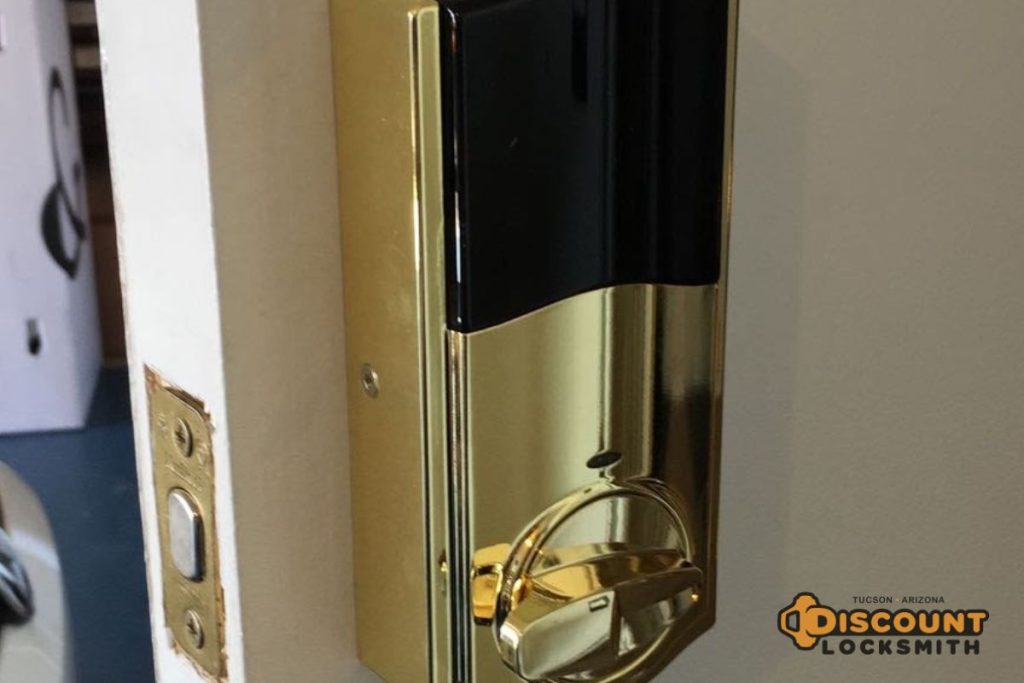
4) Bolt throw and bolt landing (deadbolt physics)
A deadbolt that doesn’t extend fully is either binding, misaligned, or hitting frame material before it reaches full throw.
What a pro checks: bolt throw length, landing clearance, and whether bolt tip shows scuffing from misalignment.
If you’re upgrading the whole assembly, it’s also worth understanding lock grades (Grade 1–3) as defined in ANSI/BHMA frameworks—here’s a simple reference on ANSI/BHMA product grade levels.
5) Cylinder tolerances and plug rotation (where “almost smooth” fails)
Cylinder wear doesn’t always feel like “broken.” It feels like “sometimes it turns, sometimes it doesn’t.” Heat and dust accelerate this.
What a pro checks: plug rotation smoothness, keyway wear, and whether the cylinder is the correct type for the door’s use level.
If you want tighter key control or upgraded cylinders, review high-security and smart locks (selection and fit matter more than marketing features).
6) Key blank wear (your key is a wearable part)
Worn keys cause more service calls than people realize. Edges round off, shoulders wear, and the key stops lifting pins/wafers precisely—especially in high-use doors and fleet vehicles.
What a pro checks: key wear pattern, whether the cut matches the lock’s specification, and whether a fresh key resolves drift symptoms.
If you need a verified copy, see key duplication and cutting.
7) Pin-tumbler vs wafer behavior (why symptoms differ)
- Pin-tumbler cylinders (common in many doors) react strongly to key precision and pin/spring condition.
- Wafer systems (common in automotive ignitions/doors) react strongly to wear, contamination, and key edge rounding.
What a pro checks: which mechanism you’re dealing with and whether symptoms match wear vs alignment vs contamination.
8) Mounting integrity (loose hardware creates phantom problems)
Loose screws, worn through-bolts, and shifting trim cause intermittent binding and misalignment. People often replace the “lock” without fixing the mounting stack.
What a pro checks: fastener condition, door prep integrity, and whether the lock body is shifting under torque.
For businesses with high-use doors, planned service often includes commercial lock maintenance and upgrades and hardware like door closers and panic bar hardware.
9) Rekey strategy and key-system logic (stop “mystery keys” issues)
Repeat problems can be authorization problems: too many keys in circulation, inconsistent key copies, or mixed cylinders that don’t match a clear plan.
What a pro checks: key-control needs, rekey history, and whether rekeying is the correct corrective step.
When rekeying is the best answer, start with lock rekeying service and (for move-ins) this guide on changing locks after moving in Tucson.
The repeat-problem matrix (short, practical, measurable)
| Repeat issue | What you feel | Typical root cause | What we verify |
|---|---|---|---|
| Key drags | gritty turn | dust + wear | keyway condition |
| Needs “push” | door must be forced | sag / strike drift | alignment + engagement |
| Won’t deadbolt | stops short | bolt binds | throw + landing |
| Random lockouts | inconsistent operation | mounting shift | fasteners + stack |
| “New lock still bad” | same symptom | geometry unchanged | door-to-frame fit |
Quick Diagnosis: Symptom → likely cause → what a pro checks
| Symptom | Likely cause | What a pro checks |
|---|---|---|
| Key won’t start smoothly | worn key / tight keyway | key edge + cylinder feel |
| Deadbolt rubs | misalignment | bolt path + strike center |
| Handle feels heavy | latch timing drag | return action + bind points |
| Door “clicks” but won’t hold | shallow engagement | latch depth + strike pocket |
| Lock works sometimes | tolerance drift | repeat cycles under normal close |
| Key turns but bolt won’t move | internal stack issue | cam/bolt interface alignment |
| Commercial door won’t latch consistently | closer/door control mismatch | closer behavior + latch timing |
| Vehicle key feels “loose” | key/wafer wear | wear pattern + ignition feel |
(We keep all service work legal and verified. We don’t provide bypass methods.)
Rekey, repair, or upgrade: choosing the right path
Rekey makes sense when the lock hardware is mechanically sound but key control or authorization is the issue (move-ins, employee turnover, lost keys).
Repair/realign makes sense when door geometry, strike alignment, or mounting integrity is the actual cause.
Upgrade makes sense when the door is high-use, high-risk, or repeatedly chewing through low-grade components.
Bold takeaway: A “cheap” lock that fails twice costs more than a correctly matched grade lock installed and aligned once.
Automotive repeat issues (no gimmicks, just mechanisms)
In Tucson, automotive lock issues often show up as: worn keys, intermittent ignition feel, or authorization-related symptoms. Modern systems also involve transponder/immobilizer authorization concepts—your vehicle decides whether a key is authorized, and we handle this within legal, verified service.
Relevant service pages:
Where we work in Tucson (and why local geometry matters)
Door construction and hardware vary a lot by neighborhood and building era. We serve central and surrounding areas like Downtown Tucson and Oro Valley, and we adjust recommendations based on door type, traffic level, and environment.
If you want the full breakdown of coverage, start at service areas.
FAQs
1) Why does my lock work fine in the morning but stick later?
Temperature swings change door fit and internal clearances. If you already have borderline alignment, heat expansion makes the bind show up later in the day.
2) Is it usually the lock or the door?
A lot of “lock problems” are door geometry problems—sag, strike drift, and shallow engagement. The fix lasts when alignment is corrected first.
3) Should I rekey or replace after moving?
If the hardware is solid, rekeying is often the clean answer. If the lock is worn, misaligned, or low-grade for the door’s use, replacement or upgrade can be smarter.
4) Do smart locks eliminate mechanical problems?
No—smart locks still depend on door alignment and proper latch engagement. Misalignment can cause battery drain and intermittent locking even with good electronics.
5) Why do keys wear out so quickly on some doors?
High-use doors, poor key copies, and gritty keyways accelerate wear. A fresh, correctly cut key often reveals whether the problem is the key, the cylinder, or alignment.
6) What causes repeated commercial door latch failures?
Traffic load plus door closer behavior plus strike alignment. If the closer timing is off or the door doesn’t close consistently, the latch can’t seat reliably.
7) Can a worn vehicle key cause ignition trouble?
Yes. Worn key edges can change how wafers interact, and modern authorization systems can add separate “not recognized” symptoms. Diagnosis needs verification and the right service path.
8) How do I avoid getting stuck again after it’s fixed?
Make sure the service included alignment checks, strike engagement verification, and key condition review—not just swapping a part. Repeat prevention comes from measured corrections.
What to Do Now
If your lock problems keep returning, the real issue is usually alignment, timing, or tolerance drift—not “bad luck.” Tucson heat cycles and dust make borderline hardware fail sooner and more often.
The correct path is a measured diagnosis: door geometry, strike engagement, latch timing, cylinder condition, and key wear—then the right repair, rekey, or upgrade based on what we verified.
Learn more about our team on the About us page, review our full services, or reach out through contact. We’re a local mobile locksmith serving Tucson daily (standard hours 6:00 AM–9:30 PM), and our process focuses on durable results.
Call (520) 994-8773 to schedule service and reduce repeat failures the right way.
Directions and reviews: Google Maps
Updates and tips on our social channels: https://www.facebook.com/DiscountLocksmithTucsonAZ/
For security and liability, we always verify authorization before work, and we avoid methods that create high-security risks or unnecessary damage.